Alberta Labour Market Brief · October 2026
Alberta is still growing. Slower now, and not everywhere.
October brought job losses and higher unemployment, while annual employment, wages, and hours worked continued to grow.
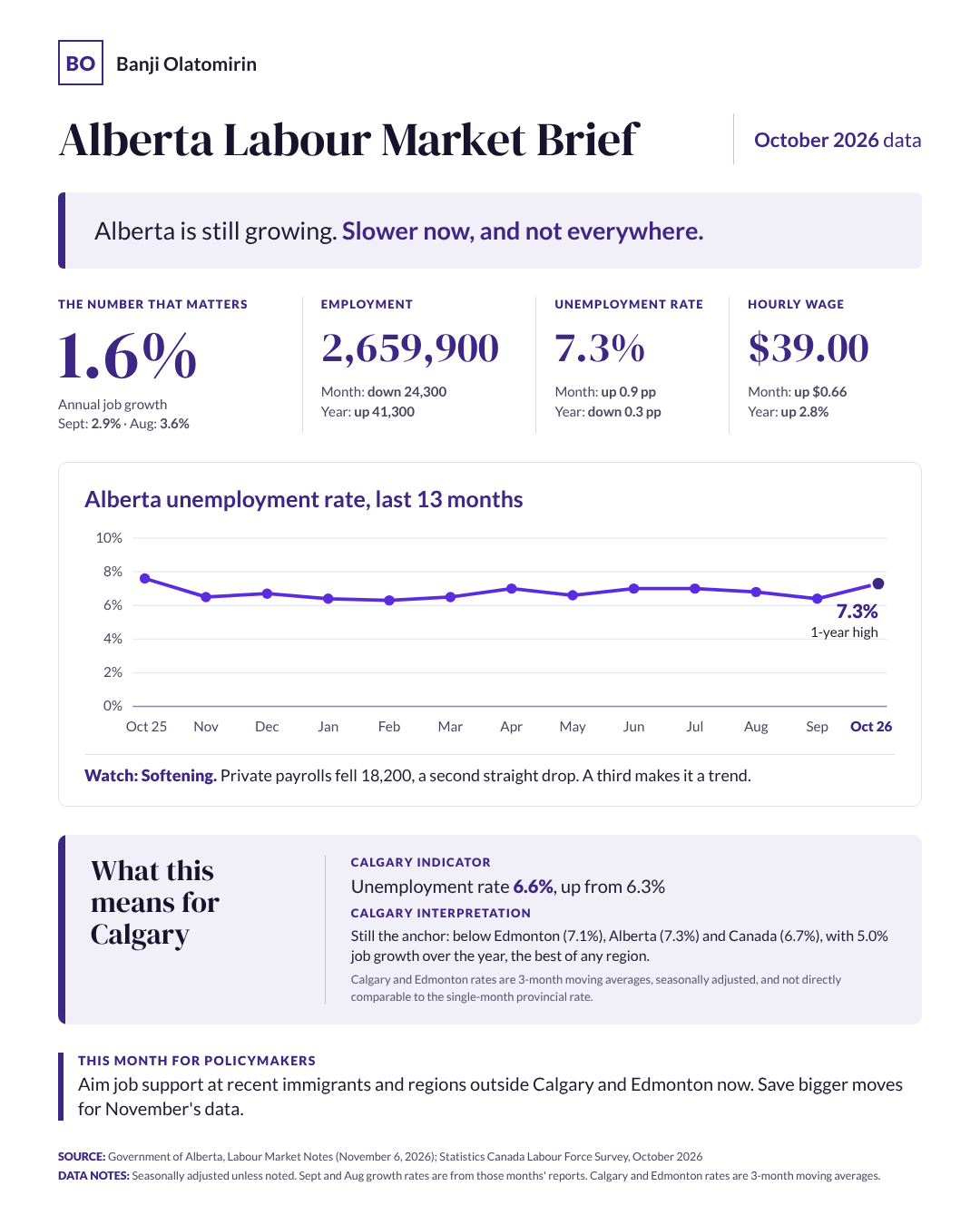
Alberta's labour market took a step backwards in October. The province lost 24,300 jobs, and unemployment climbed to 7.3%, its highest level in a year.
That is a sharp change from September. More than 26,000 people joined the ranks of the unemployed, even as fewer people participated in the labour market. This wasn't simply a case of more Albertans entering the job market and struggling to find work. Employment fell, and people felt the impact.
The losses were concentrated in services, particularly transportation and warehousing, professional services, and wholesale and retail trade. Together, these industries accounted for much of the decline. Meanwhile, construction and other goods-producing industries added jobs.
There is another part of the story worth watching. Private employers cut 18,200 jobs, marking a second consecutive monthly decline. Self-employment also fell by 18,700 after its sharp increase in September. Public-sector employment provided some relief, adding 12,600 jobs.
In other words, the slowdown is not limited to traditional employers. Both businesses and people working for themselves felt the pullback.
The bigger picture is more complicated
Despite October's losses, Alberta is not in a jobs slump. The province has added 41,300 jobs over the past year, representing 1.6% growth. That is slower than earlier in the year, but still ahead of Canada's 0.1%.
There are also some encouraging signs beneath the headline numbers. Full-time employment is up 83,800 over the year, and total hours worked have increased by 5.7%. Employers may be more cautious about adding people, but the amount of work being done across the province has continued to grow.
Pay is another bright spot. Alberta's average hourly wage reached $39.00, up 2.8% from a year ago. That is now ahead of Canada's 2.2% wage growth, reversing the gap we saw in September.
So the picture is mixed. Fewer people are employed than last month, but the province is still ahead of last year's employment levels. Wages are improving, and full-time work has held up better than the headline employment figure suggests.
Calgary is holding up. The rest of Alberta needs attention.
Calgary remains one of the province's stronger labour markets. Its unemployment rate rose to 6.6%, but that is still below Edmonton's 7.1% and Alberta's overall rate of 7.3%.
Calgary also leads the province's economic regions in employment growth so far this year, at 5.1%. Edmonton follows at 4.1%.
Outside these two major cities, the picture is less encouraging. Employment across the rest of Alberta is below where it was a year ago. That matters because a provincial average can hide very different experiences depending on where someone lives and works.
The pressure is also not being shared equally among workers. Unemployment among immigrants aged 25 to 54 who arrived in Canada within the last five years has increased by 1.8 percentage points over the year. Among Canadian-born workers in the same broad age group, it has fallen by one percentage point.
That gap deserves attention. Newcomers already face the challenge of building professional networks, gaining Canadian work experience and establishing themselves in a new labour market. A weaker employment environment can make that transition even harder.
What this means for policymakers
For policymakers, the pressure is becoming more concentrated. Employment support should pay closer attention to communities outside Calgary and Edmonton, as well as newcomers who are experiencing a very different labour market from Canadian-born workers. A province can post positive annual growth while important groups and regions fall behind.
I would not sound the alarm just yet. One difficult month does not establish a trend, especially when annual employment, wages and hours worked are still growing.
But October is a warning worth taking seriously. Private-sector employment has declined twice in a row, unemployment is rising, and the recovery is becoming less evenly shared across the province.
November's numbers will tell us whether this is a temporary setback or the beginning of a more sustained slowdown.
Alberta is still growing. Slower now, and not everywhere.